Ever watched a flat piece of cardboard transform into a perfectly sealed box in seconds? That’s the power of a folder gluer machine—a cornerstone of modern packaging automation. As e-commerce volumes surge and brands demand faster turnarounds, understanding this equipment isn’t optional anymore.
A folder gluer machine is an automated system that folds flat cardboard blanks along pre-scored lines and applies adhesive to create finished cartons, eliminating manual assembly in high-volume packaging operations. The global folder gluer machine market exceeded USD 678.4 million in 2025 and is projected to grow at a 6.8% CAGR through 2035, driven by rising demand for efficient packaging solutions across industries.
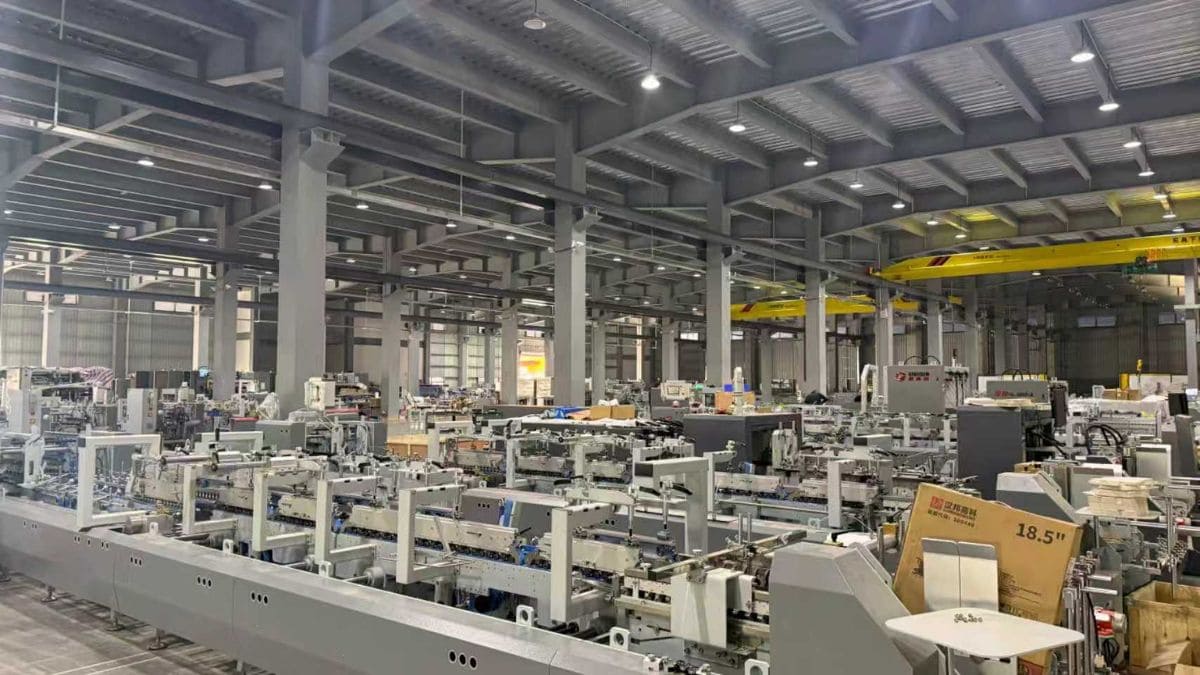
Why does this matter to B2B packaging equipment buyers? Because production speed, labor costs, and quality consistency directly impact your bottom line. A well-chosen folder gluer can double your output while cutting defect rates below 1.5%, making it a strategic investment rather than just another piece of machinery.
What Exactly Is a Folder Gluer Machine?
To be honest, many packaging professionals still confuse folder gluers with die-cutting equipment. Let me clarify: while die-cutters create the blank, folder gluers bring it to life. This distinction becomes critical when you’re planning production workflows or evaluating equipment ROI.
A folder gluer machine is an automated packaging system that takes flat, die-cut cardboard blanks and transforms them into three-dimensional cartons through sequential folding and gluing operations, handling speeds from 150 to 400 meters per minute depending on box complexity and material specifications.
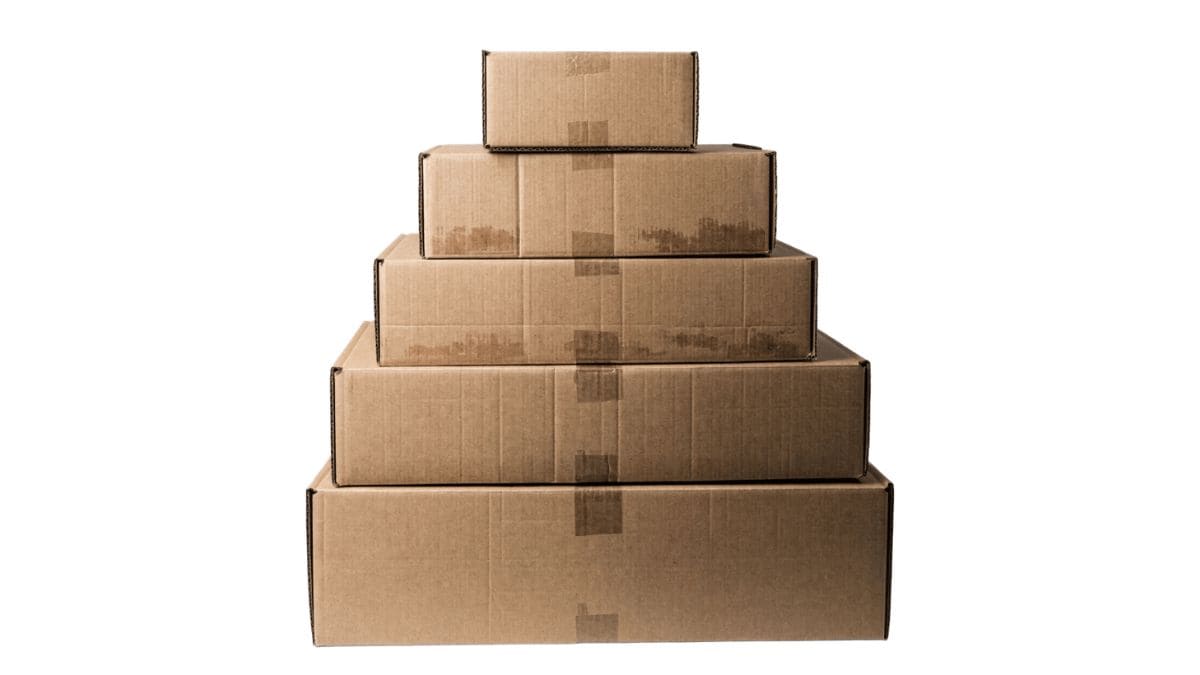
The machine serves as the bridge between printing and packing. After your blanks exit the die-cutter or printing press, they enter the folder gluer as flat sheets. Within seconds, precision folding mechanisms crease panels, glue applicators deposit adhesive at exact locations, and compression sections bond the structure. What emerges is a finished carton ready for your packing line—no manual intervention required.
Core Definition and Purpose
What problem does this equipment actually solve? In my experience, three pain points drive most folder gluer purchases:
- A folder gluer machine automates the folding and gluing of flat cardboard blanks into finished cartons, replacing labor-intensive manual processes that typically require 3-5 workers per shift and introduce human error rates of 2-4% in high-volume operations.
- It handles production volumes that manual methods cannot sustain—a mid-range automatic folder gluer processes 200-300 cartons per minute, equivalent to the output of 15-20 skilled manual workers, while maintaining consistent quality across millions of units.
- The system accommodates diverse box styles from simple straight-line cartons to complex 4/6 corner designs, crash-lock bottoms, and special-shaped packaging, enabling packaging plants to serve multiple clients without investing in separate equipment for each box type.
Industry Context and Terminology
Here’s where terminology gets confusing. Different regions use different names for essentially the same equipment:
- The term "folding and gluing machine" dominates European markets, while North American buyers typically search for "carton folder gluer" or simply "folder gluer"—all referring to the same core technology with minor regional specification differences.
- This equipment serves as essential infrastructure in printing plants, packaging converters, and corrugated box manufacturers worldwide, with over 8,000 installations across China alone and thousands more in Southeast Asia, Europe, and North America.
- Modern folder gluers integrate seamlessly with upstream printing presses and downstream automatic stackers or robotic packing systems, creating end-to-end automation that reduces labor costs by 60-70% compared to semi-automated workflows.
Understanding these terms matters when you’re sourcing equipment internationally or comparing specifications across suppliers. A "folding gluing machine" quote from a European manufacturer and an "automatic folder gluer machine" proposal from an Asian supplier might describe identical capabilities—knowing the terminology prevents you from overlooking qualified vendors.
The Historical Development of Folder Gluer Machines
Most buyers don’t realize how recent this technology actually is. The first commercial folder gluers appeared in the 1960s, meaning the industry has compressed seven decades of innovation into equipment that now rivals CNC machining in precision. That rapid evolution explains why older models depreciate quickly—technology leaps happen every 5-7 years.
Folder gluer machines evolved from basic mechanical folding devices in the mid-20th century to today’s intelligent, servo-driven systems capable of 400-meter-per-minute speeds with inline quality inspection, reflecting the packaging industry’s shift from labor-intensive manual processes to fully automated, data-connected production environments.
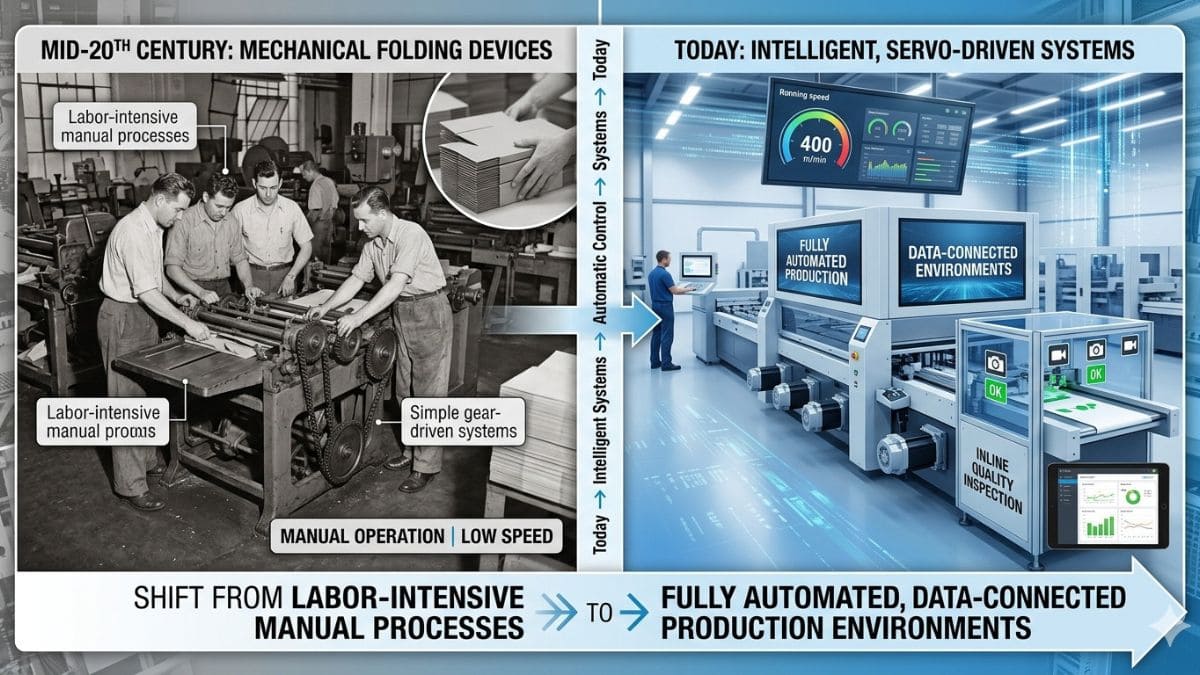
This historical context helps explain why equipment selection feels overwhelming. You’re not just choosing between brands—you’re choosing between technological generations. A 2015 model and a 2025 model might share the same nameplate but represent entirely different capabilities in terms of speed, flexibility, and integration potential.
Early Mechanical Era
The first folder gluers were remarkably simple machines. Think of them as motorized versions of manual folding jigs:
- Initial folder gluer designs emerged in the 1950s-1960s as basic mechanical systems using fixed gear ratios, leather belts, and cam-driven folding arms to process simple straight-line boxes at speeds of 30-50 meters per minute—roughly 10 times faster than manual methods but requiring frequent manual adjustments for different box sizes.
- Early models relied entirely on mechanical timing, with operators manually adjusting folding hooks, glue wheel positions, and belt tensions using wrenches and gauges, making job changeovers take 2-3 hours and limiting most plants to running the same box style for days at a time.
- Adoption accelerated through the 1970s-1980s alongside the expansion of consumer packaged goods and retail distribution networks, as brands like Kellogg’s and Procter & Gamble demanded consistent, high-volume carton production that manual methods could not economically deliver.
Transition to Automation and Servo Technology
The real revolution came with electronics. I’ve seen plants upgrade from mechanical to servo systems and cut their setup times from hours to minutes:
- The introduction of servo motors and programmable logic controllers (PLCs) in the 1990s-2000s transformed folder gluers from fixed-speed mechanical devices into flexible, high-precision systems capable of storing job parameters digitally and adjusting speeds dynamically based on material thickness and box complexity.
- Memory storage functions and color touchscreen interfaces became standard features by the mid-2000s, allowing operators to recall complete job setups with a single button press and reducing changeover times from 90+ minutes to under 15 minutes for experienced crews.
- Global manufacturers, particularly those in China’s Guangdong Province, accelerated innovation in high-speed and multifunctional models during the 2010s, introducing features like automatic feeder gap adjustment, motorized folding hook positioning, and wireless remote diagnostics that previously existed only on premium European equipment.
Current State of Intelligent Systems
Where are we now? The latest generation of folder gluers looks more like industrial robots than traditional packaging equipment:
- Modern folder gluer machines incorporate inline camera-based inspection systems that detect printing defects, color deviations, and barcode errors at speeds up to 400 meters per minute, automatically ejecting faulty cartons before they reach the gluing section—a capability that reduces waste by 30-40% in high-quality packaging applications.
- Energy-efficient full servo motor systems now define premium equipment, with independent servo drives controlling each major section (feeding, folding, gluing, delivery) to reduce power consumption by 20% compared to belt-driven designs while enabling precise speed synchronization across all stations.
- The technology continues evolving toward full Industry 4.0 integration, with current models offering OPC-UA connectivity, cloud-based production monitoring, predictive maintenance alerts based on vibration analysis, and automatic job scheduling that coordinates folder gluer operations with upstream printing presses and downstream packing robots.
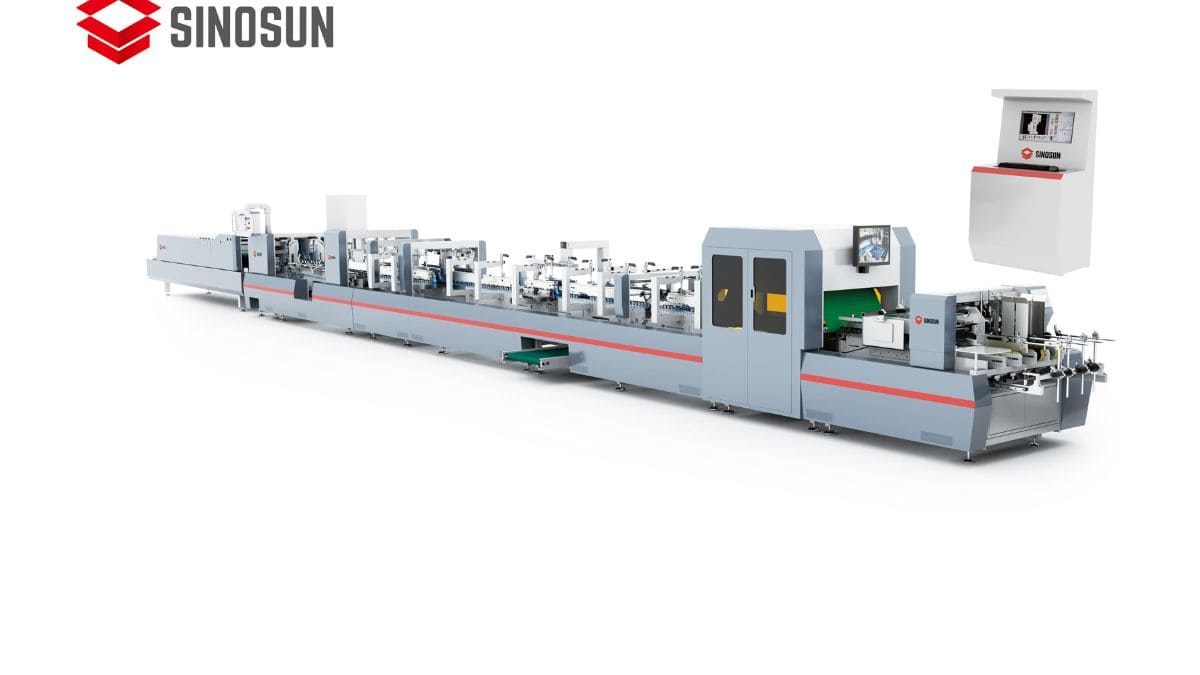
This evolution matters because it affects your total cost of ownership. A 2026-spec intelligent folder gluer might cost 30% more upfront than a 2018 model, but the energy savings, reduced waste, and faster changeovers typically deliver payback within 18-24 months in high-volume operations.
How Does a Folder Gluer Machine Work?
Here’s what surprises most first-time buyers: the working principle is elegantly simple, but the execution requires extreme precision. A folder gluer essentially performs three actions—fold, glue, press—but it must do so at speeds where a 0.5mm misalignment creates a defective carton. That’s why understanding the fundamentals helps you evaluate whether a supplier’s claims are realistic.
A folder gluer machine operates by transporting flat cardboard blanks through synchronized stations where mechanical folding devices crease panels along scored lines, precision glue applicators deposit adhesive at programmed locations, and compression belts bond the folded sections together—all controlled by electronic systems that maintain timing accuracy within milliseconds across speeds ranging from 150 to 400 meters per minute.
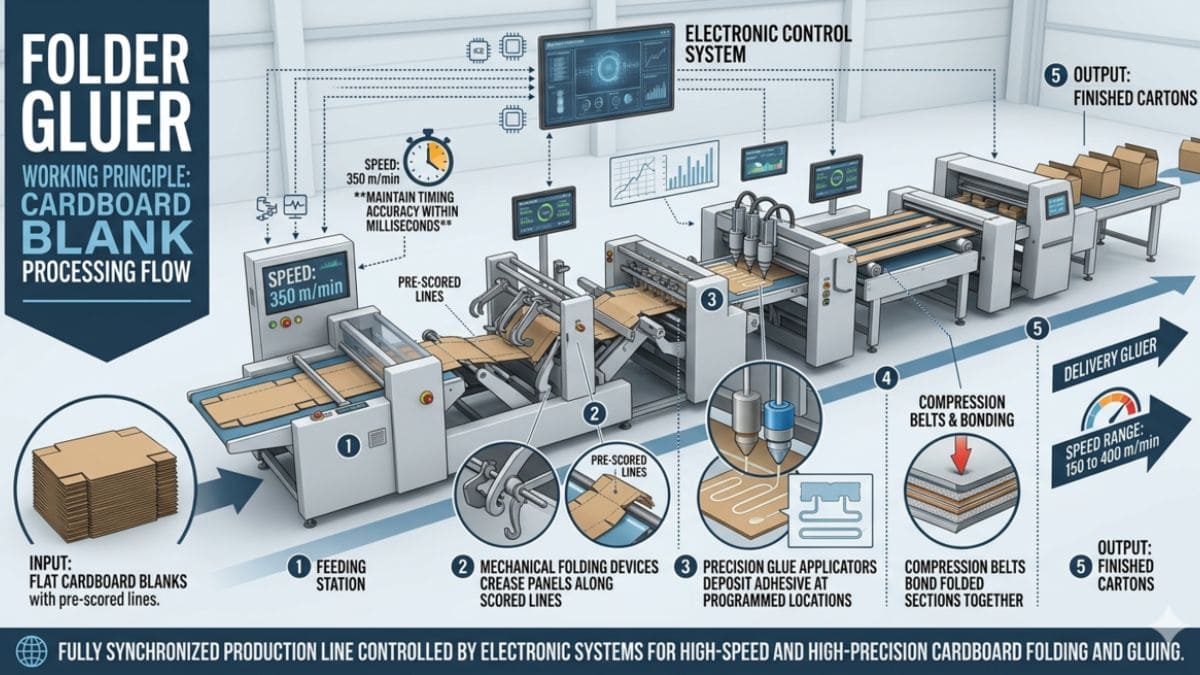
Think of it as an assembly line compressed into a single machine. Each station performs one specific task, and the magic happens in the coordination. When you see a folder gluer running smoothly, you’re watching dozens of motors, sensors, and mechanical components working in perfect synchronization—which is also why maintenance and operator training matter so much.
Overall Production Flow
Let’s walk through what actually happens inside the machine. I always tell buyers to observe a live demonstration because seeing the flow helps you understand why certain features matter:
- Flat cardboard blanks enter the machine through the feeding section, where vacuum suction cups or friction wheels separate individual sheets from a stack and position them onto a continuous belt conveyor system that maintains precise spacing between blanks throughout the entire process.
- Blanks progress through sequential stations—pre-folding hooks initiate the first creases, main folding sections complete the panel bends, glue wheels or nozzles apply adhesive to designated flaps, and compression belts press the glued areas together for 3-5 seconds to achieve initial bond strength.
- Finished cartons exit the machine through the delivery section, where they are either manually collected in batches, automatically stacked by a robotic stacker, or fed directly into a downstream packing line—the choice depends on your production volume and labor availability.
Fundamental Mechanical Principles
The physics behind folder gluers is straightforward, but the engineering is sophisticated. Three core mechanical systems make everything work:
- Precision timing belts and vacuum-assisted carriers maintain accurate blank positioning throughout the machine, using encoder feedback to ensure each blank arrives at folding and gluing stations within ±0.5mm of the programmed position—critical for preventing glue misalignment or incomplete folds on complex box styles.
- Glue application systems deposit adhesive at exact locations and quantities using either rotating glue wheels (for cold glue) or heated nozzles (for hot-melt adhesive), with flow rates controlled by servo pumps that adjust output based on belt speed to maintain consistent bead width from 2mm to 15mm depending on box requirements.
- Folding mechanisms employ a combination of stationary hooks, rotating wheels, and pneumatic guides to create clean creases and accurate panel angles, with adjustable hook positions allowing the same machine to handle box styles ranging from simple straight-line cartons to complex 4/6 corner designs without mechanical retrofits.
Role of Control Systems
This is where modern folder gluers separate themselves from older equipment. The control system is the brain that makes everything else possible:
- Electronic control systems synchronize all mechanical sections to maintain consistent output at speeds from 50 to 400 meters per minute, using PLCs and servo drives to adjust belt speeds, folding timing, and glue application rates in real-time based on material thickness and box complexity.
- Optical sensors and encoders monitor paper flow, blank alignment, and glue application accuracy throughout the process, triggering automatic stops if blanks jam, glue flow drops below programmed levels, or alignment drifts beyond tolerance—preventing the production of defective cartons and reducing material waste.
- Operator interfaces built around 10-inch or larger color touchscreens allow rapid job recall from memory storage (up to 4,000 saved jobs on premium models), one-touch parameter adjustments, and real-time production monitoring showing current speed, carton count, and efficiency metrics—capabilities that reduce operator training time from weeks to days.
Understanding these principles helps you ask the right questions during equipment evaluations. When a supplier claims their machine handles "all box types," you can probe deeper: What’s the hook adjustment range? How does the control system compensate for material thickness variations? Can the glue system switch between hot-melt and cold glue without hardware changes?
Main Modules and Components of a Folder Gluer Machine
Most buyers focus on headline specs—speed, width, price—and overlook the modular architecture that determines long-term flexibility. A folder gluer isn’t a monolithic machine; it’s a collection of specialized modules that work together. Understanding each module’s function helps you identify which upgrades matter for your specific applications and which are just marketing features.
A complete folder gluer machine comprises four primary functional modules—feeding/alignment, pre-folding/folding, gluing/pressing, and delivery/collection—each performing distinct operations that must be precisely synchronized to achieve consistent output quality at speeds ranging from 150 to 400 meters per minute across diverse box styles and material specifications.
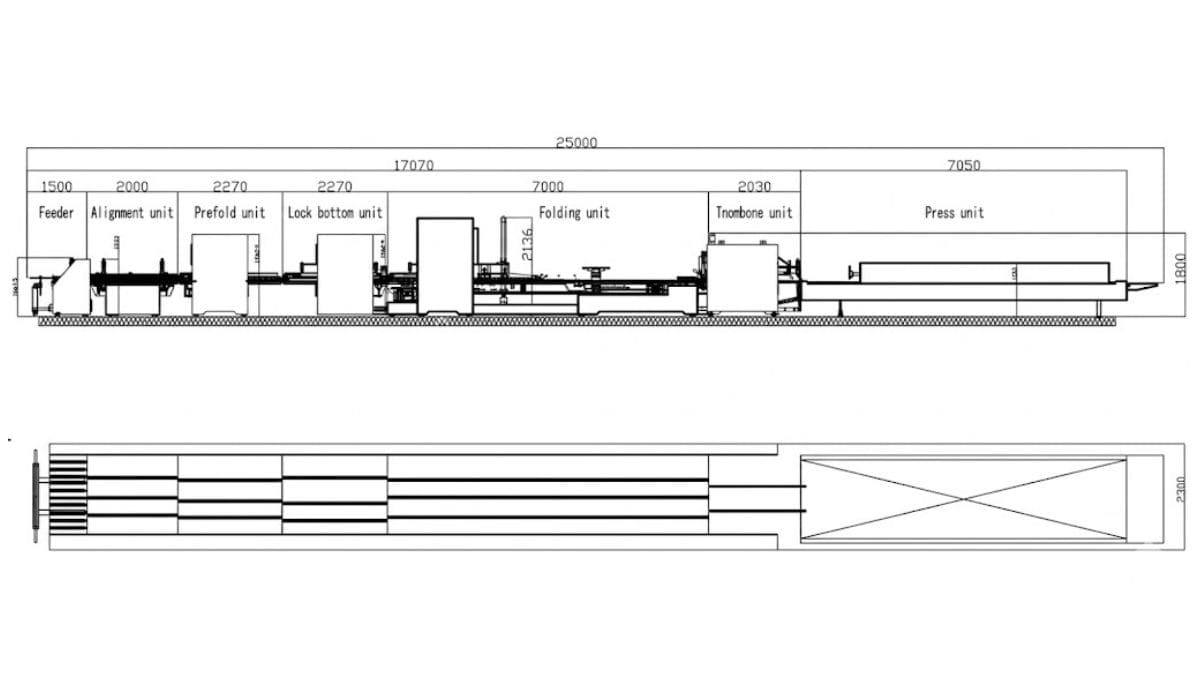
This modular design offers a hidden advantage: you can often upgrade individual sections without replacing the entire machine. Need faster feeding for lightweight materials? Add a high-speed feeder module. Want inline inspection? Retrofit a camera system into the delivery section. This modularity is why some 10-year-old folder gluers still compete with new equipment after targeted upgrades.
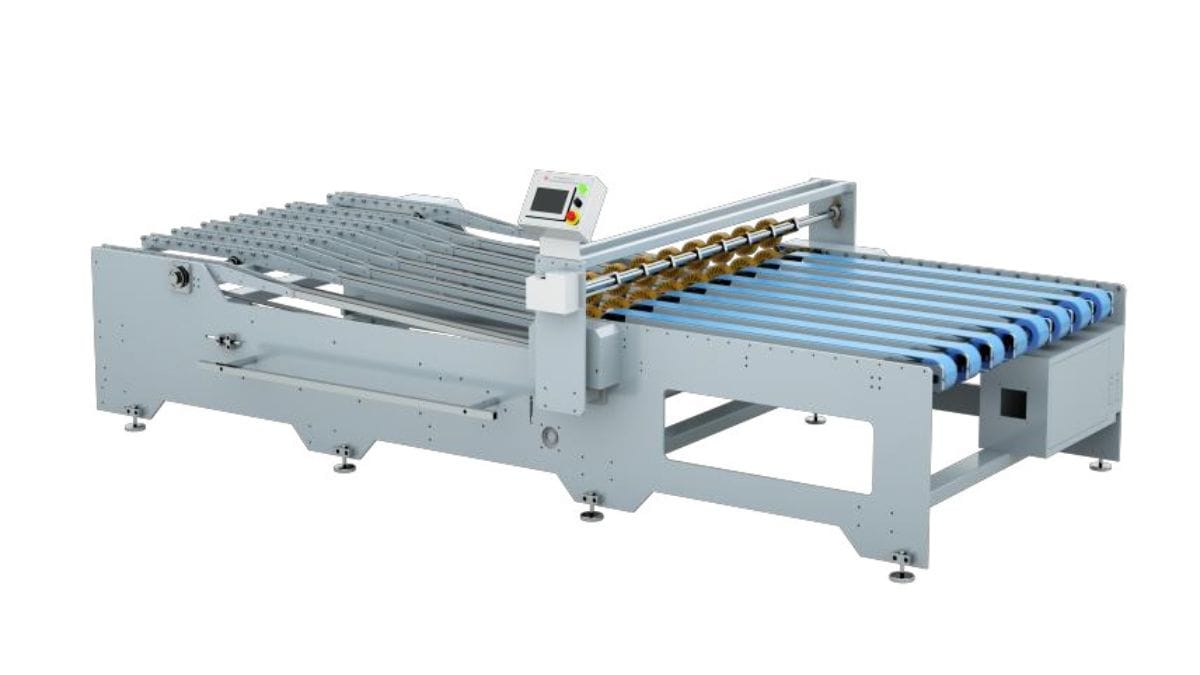
Feeding and Alignment Section
The feeding section is where most production problems start. I’ve seen plants struggle with 10-15% waste rates, only to discover their feeder couldn’t handle the paper thickness variation in their material supply:
- The feeding section separates and transports individual blanks from a stacked pile using vacuum suction cups or friction rollers, with adjustable gap settings accommodating material thicknesses from 200g/m² lightweight cardboard to 800g/m² heavy corrugated board—critical for plants running diverse product mixes without frequent mechanical adjustments.
- Precision side guides and front stops ensure each blank enters the main conveyor system in perfect alignment, preventing angular misalignment (skewing) that would cause glue to miss target areas or folding hooks to catch panels incorrectly—a single misaligned blank can jam the entire machine and halt production.
- Optional configurations include anti-scratch prefeeders using soft suction belts for delicate gold/silver foil surfaces, non-stop automatic feeders that reload stacks without stopping production, and dual-feeder systems that join two separate blanks into a single large box—features that expand application range but add 15-30% to base equipment cost.
Pre-folding and Folding Sections
This is where the magic happens—flat becomes three-dimensional. The folding section’s complexity scales directly with box style variety:
- Pre-folding stations initiate the first creases using stationary hooks or rotating wheels that gently bend panels along die-cut score lines, preparing the blank for final forming while avoiding sharp creases that could crack coated surfaces or damage printed graphics.
- Main folding sections complete the transformation using a combination of mechanical hooks, pneumatic guides, and compression rollers to create precise 90° or 180° folds, with adjustable hook positions enabling the same machine to produce simple straight-line cartons, crash-lock bottoms, 4/6 corner boxes, and special-shaped designs without mechanical retrofits.
- Advanced models incorporate hookless folding mechanisms for crash-lock bottoms and backfold capabilities for complex multi-panel boxes, technologies that increase production speed by 20-30% compared to traditional hook-based systems while reducing setup time and mechanical wear on high-volume runs.
Gluing and Pressing Sections
Glue application looks simple but requires surprising precision. The difference between a 98% yield and a 99.5% yield often comes down to glue system performance:
- Glue applicators deposit adhesive precisely to designated flap areas using either rotating wheels (for cold glue) or heated nozzles (for hot-melt systems), with servo-controlled pumps adjusting flow rates from 50ml/min to 500ml/min based on belt speed and box size to maintain consistent bead width and prevent glue starvation or overflow.
- Compression belts and heated pressing plates bond folded sections together with controlled pressure (typically 0.3-0.8 MPa) and dwell time (3-8 seconds depending on adhesive type), ensuring strong, consistent bonds while preventing panel crushing on lightweight materials or incomplete adhesion on thick corrugated board.
- Premium systems support both hot-melt and cold-glue application through quick-change glue heads, offer automatic glue temperature control (maintaining ±2°C stability for hot-melt systems), and include glue level sensors that alert operators before reservoirs run dry—features that reduce unplanned downtime and material waste in high-volume operations.
Delivery and Collection Section
The delivery section determines whether your folder gluer integrates smoothly with downstream processes. This often-overlooked module affects your labor requirements and packing line efficiency:
- The delivery section collects finished cartons and organizes them into neat stacks or batches for easy removal, using adjustable conveyor speeds and pneumatic joggers to align cartons precisely before stacking—critical for maintaining production flow when operators manually transfer batches to packing stations.
- High-speed models maintain production rates up to 400 meters per minute while ensuring orderly output through dynamic speed compensation, where the delivery conveyor automatically accelerates or decelerates to create consistent spacing between cartons regardless of box length variations within a production run.
- Integration options include automatic stackers that robotically build palletized loads, inline counters that trigger batch separation at programmed quantities, and direct feeds to downstream packing lines or shrink-wrap systems—automation that eliminates 2-3 manual handling positions and reduces labor costs by 40-50% in high-volume operations.
When evaluating folder gluers, ask suppliers to explain each module’s upgrade path. Can you add a non-stop feeder later? Is the gluing section compatible with both adhesive types? Does the delivery section support automatic stacker integration? These questions reveal whether you’re buying a fixed system or a flexible platform.
Conclusion
Understanding what a folder gluer machine is—from its core definition and historical evolution to working principles and modular components—empowers packaging buyers to make informed equipment decisions. Sinosun offers 16 specialized models across HL, YZ, YL, GL, JD, and XCS series to match diverse production requirements. Explore our complete product range or contact our team for personalized equipment recommendations today.